Introduction.
In recent months, the Democratic Republic of Congo (DRC) has witnessed a dramatic resurgence in the use of capital punishment, particularly targeting armed robbers and so-called “urban bandits.” locally called ‘Kulunas’ This blog delves into the reasons behind these executions, examining the socio-political context, public sentiment, and the broader implications for human rights and justice and recommendations in the DRC.
Background.
The country has seen a significant increase in urban and organized crime, particularly in major cities like Kinshasa,Kisangani,Goma among others. Armed robbery, carjacking, and violent assaults have become more common, contributing to a heightened sense of insecurity among residents. The government has faced mounting pressure to address this surge in crime and restore public order. The executions were seen as a drastic measure to deter criminal activities and reassure the public.
Reinstatement of the Death Penalty.
After a 20-year moratorium on executions, the DRC reinstated the death penalty in March 2024. Initially intended to combat militant violence, this policy was expanded to include civilian crimes such as armed robbery. The decision to resume executions was driven by a perceived need for strong punitive measures to curb rising crime rates, escalating violent and militant attacks, combating treason and espionage and political and military strategy.
Public Pressure for Safety
Public sentiment played a crucial role in the government’s decision to resume executions. Many citizens, frustrated by the high levels of crime and feeling unsafe in their communities, supported harsh measures against criminals. The executions were seen by some as necessary to restore order and security. “We welcome this decision by the minister because it will help put an end to urban crime. From 8 p.m. onwards, you can’t move around freely because you’re afraid of running into a Kuluna,” said Fiston Kakule, a resident of the eastern city of Goma. The DRC had a history of using the death penalty, and its reinstatement after a 20-year moratorium was seen by some as a return to a familiar and previously accepted form of punishment for serious crime
Human Rights Concerns
Despite the government’s intentions, these actions have sparked significant criticism from human rights organizations. Critics argue that the executions represent a gross violation of human rights and question the effectiveness of capital punishment as a deterrent. There are concerns about the fairness of trials and the potential for extrajudicial killings. Espoir Muhinuka, a human rights activist, warned of the possibility of extrajudicial executions and called for a strict respect for judicial procedures and fundamental guarantees. He fears that political pressure could lead to unjust convictions and arbitrary executions. (CNN).
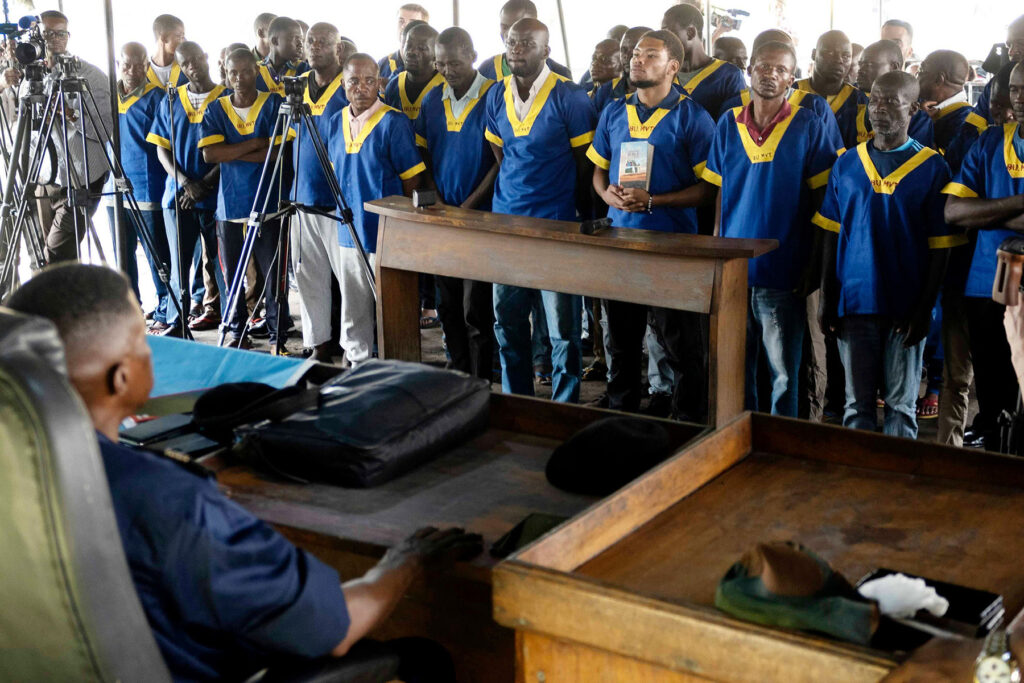
In September 2024, a military court in Congo handed down death sentences on Friday to 37 people, including a Canadian, after convicting them on charges of participating in a coup attempt. The defendants, most of them Congolese but also including a Briton, Belgian and three Americans, had five days to appeal the verdict on charges that include an attempted coup, terrorism and criminal association. Fourteen people were acquitted in the trial, which began in June. The open-air military court in the capital, Kinshasa, convicted the 37 defendants and imposed “the harshest penalty, that of death” in the verdict delivered in French by presiding judge Maj. Freddy Ehuma. Global Affairs Canada is aware of reports that a Canadian citizen was sentenced to death in the Democratic Republic of Congo,” the agency told CBC News in an email
Recommendations
The situation in the DRC is complex and requires a multidimensional approach. The fight against urban gangs must go hand in hand with efforts to combat poverty, unemployment and social exclusion, which are often contributing factors to crime. Obviously, the experience in the past didn’t produce the needed results. Most countries in Africa have halted this act but rather focused on other punitive measures with maximum results. Algeria abolished public executions in 1993, Burkina Faso in 1988, Benin in 1987 and Ghana in 1993.
Amnesty International opposes the death penalty because it violates fundamental human rights, including the right to life and freedom from cruel, inhuman, or degrading treatment. The death penalty is irreversible, and the risk of executing innocent people due to flawed trials, inadequate legal representation, or discriminatory practices can never be eliminated. It disproportionately affects marginalized groups and is often used as a political tool to suppress dissent. Additionally, there is no evidence that it deters crime more effectively than other punishments like life imprisonment. Amnesty International views the death penalty as inherently cruel and unjust, advocating for its global abolition to promote a fairer and more humane justice system. Over 112 countries have already abolished it, reflecting a growing international consensus against its use.
As MSc Geography candidates with a concentration in the Anthropocene at the University of Ottawa, our research focuses on the complex relationship between human societies, environmental change, and governance. The resurgence of capital punishment in the Democratic Republic of Congo (DRC) underscores the urgent need to address rising crime rates through policies that balance justice, human rights, and societal well-being. Studying cases like this is essential for shaping effective governance strategies that prioritize both security and human dignity in a time of unprecedented challenges.”
Authors: Foster Adamu & Dickson Awuku Bekoe
References
CBC News. (2024, September). Canadian among 37 sentenced to death in DRC coup attempt. Retrieved from [https://www.cbc.ca/news](https://www.cbc.ca/news)
CNN. (2024). Congo military court sentences 37 to death, including foreign nationals, over coup attempt. Retrieved from [https://www.cnn.com](https://www.cnn.com)
NPR News. (2024). DRC reinstates death penalty amid rising crime and public pressure. Retrieved from [https://www.npr.org](https://www.npr.org)
Actualite.cd. (2024). Congo: La peine de mort rétablie pour lutter contre la criminalité urbaine. Retrieved from [https://actualite.cd](https://actualite.cd)
Amnesty International. (2024). Death Sentences and Executions 2023. Retrieved from [https://www.amnesty.org](https://www.amnesty.org)
Photo: Samy Ntumba Shambuyi/AP