Through this article Amnesty Ottawa/Gatineau wishes to bring into focus how heatwaves affect our neighborhoods through a lens of climate justice. By focusing on lack of greenspaces, we bring into attention the difficulties faced by those without the means to stay safe from the heat and those without the ability to access places safe from heatwaves. Since vulnerability to adverse effects of high temperatures corresponds with income levels, we frame this issue as one of local climate justice tied to how our cities are built and who gets left out.
Last June Ottawa experienced its hottest day in more than 50 years at 34°C. Environment Canada issued alerts, calling on seniors and people with feeble health to stay indoors – regardless of the fact that many homes in the ‘True North’ are not built to be hospitable in such heat. Many folks cannot afford to cool their homes, while many others live in ill-ventilated apartments. These record shattering events are becoming increasingly common as climate change affects us in unprecedented ways, and extreme climatic conditions are slated to become even more intense. The first to be battered by the heat will be the most vulnerable amongst us: those feeble in health, or those with meagre wealth.
Urban Heat Islands
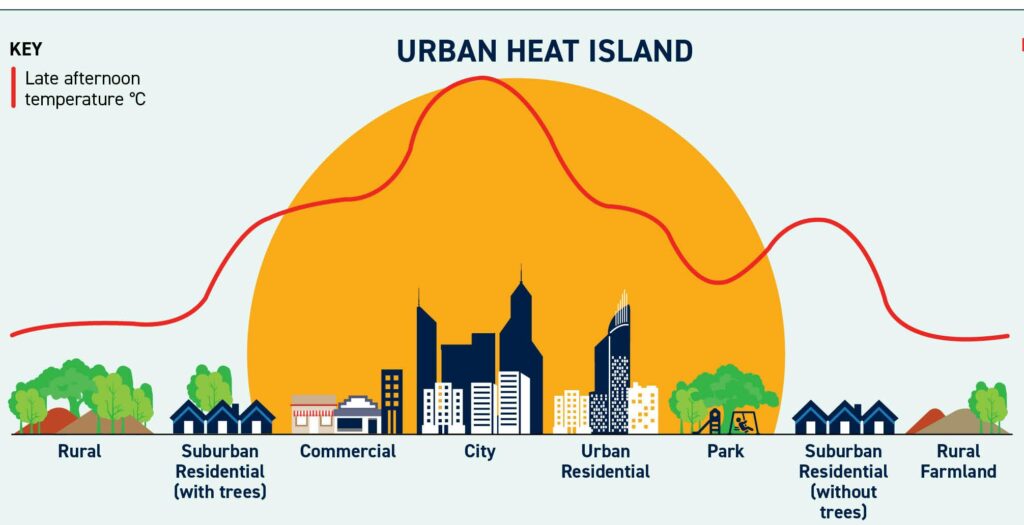
Urban infrastructure retains heat. Surfaces such as asphalt, pavements, rooftops etc. absorb heat during the day and gradually release it overnight. On the other hand, trees and green spaces help cool the air by providing shade and releasing moisture into the atmosphere. Neighborhoods with fewer trees and more built-up spaces are most likely to suffer from unhealthy heat levels even after sunset. The city of Ottawa employs the Tree Equity Score to identify areas with low canopy cover, and often these are areas with the highest social vulnerability. The neighborhoods identified tend to be lower income, overcrowded, poorly served by transit. In Ottawa, some of the most heat-vulnerable areas are both densely built and lack green infrastructure as a result of underinvestment on multiple fronts. Examples in Ottawa include the neighborhoods of Heron Gate & Vanier. According to Martha Copestake, the senior planning forester at the city of Ottawa, both these neighbourhoods were under the target 30 % canopy cover as of 2017, newer data is expected to be released late 2025.
More affluent areas tend to be better shaded, and have better access to greenspaces. Whereas denser, poorer neighborhoods where the houses are more often ill-equipped, or the residents are more likely to be financially strained and can’t afford cooling are left in want of green spaces which can serve as an oasis during sweltering temperatures. A single well-placed tree can provide shade,and clusters of trees in public parks lower the temperatures around them. Less affluent neighbourhoods lack access to public parks, or what they have tends to be poorly maintained. These differences between affluent and less affluent neighborhoods originate from years of uneven investments by the city. Everyone deserves to have a space to stay safe during a heatwave, either at home or nearby.
Solutions
Cities must focus their greening efforts at the hotspots which experience the greatest heat, instead of prioritizing the already well-served, affluent areas which hold electoral sway. Residents’ voices need to matter in the decisions in their community, they are the people who inhabit those areas, and naturally know best what needs fixing. Collaborative efforts can be undertaken with well-established grassroots groups such as Ecology Ottawa & CAFES (Community Association for Environmental Sustainability). As summer approaches, and the heat becomes undeniable, it is a good time for activists to start conversations about urban heat islands and green spaces.
By Sabrine Adjinakou & Karandeep Singh